

Going the distance: Joe’s story
From pain to diagnosis
Joe Eddison experienced reactive arthritis in 2005. By late 2008, he had developed severe back pain and stiffness that sometimes left him unable to move in the mornings.
After several years of investigations, including consideration of psoriatic arthritis and further scans, he was diagnosed with axSpA, then referred to as ankylosing spondylitis, in April 2012.
The diagnosis came through a specialist rheumatology service in Leeds, UK, approximately four years after his back symptoms began. “By that point, I could barely move,” Joe recalls. “I had put on a lot of weight and was struggling with the pain and stiffness.”
He began biologic treatment immediately after his diagnosis. It worked quickly, significantly reducing his pain and stiffness and enabling him to become active again.
That was when Joe discovered his love of walking.
Finding his happy place
Although his axSpA has generally been well managed, he still experiences symptoms including fatigue, brain fog and anxiety.
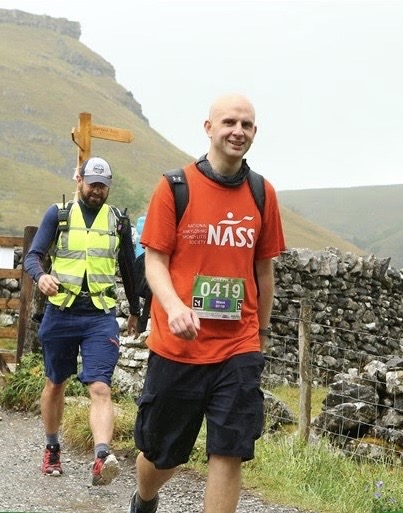
Walking has become one of the ways he responds to these challenges. “Walking is literally my mental and physical happy place,” he says. “It helps me manage morning stiffness, fatigue, brain fog and flares.”
As his fitness improved, Joe gradually started walking faster and covering longer distances. Around his work and family commitments, he now walks between 10 and 15 miles in a day, often at a pace of 4.5 to 5 miles per hour.
For Joe, the benefits are both physical and emotional. “Fast walking seems to reduce the inflammation I feel in my joints, my gut and my head,” he explains. “If I feel a flare coming, a big, fast walk can help to slow it down.”
This is Joe’s personal experience. AxSpA affects everyone differently, and the type and amount of movement that feels helpful will vary from person to person. Physical activity should always be adapted to an individual’s health, fitness and medical advice.
Walking in memory of his dad
Joe’s walking took on a new meaning after his dad died from a brain tumour in 2021.
He and a friend completed the Yorkshire Three Peaks. Joe then took part in a Macmillan Mighty Hike in his dad’s memory, giving him an opportunity to honour his dad while doing something positive for others.
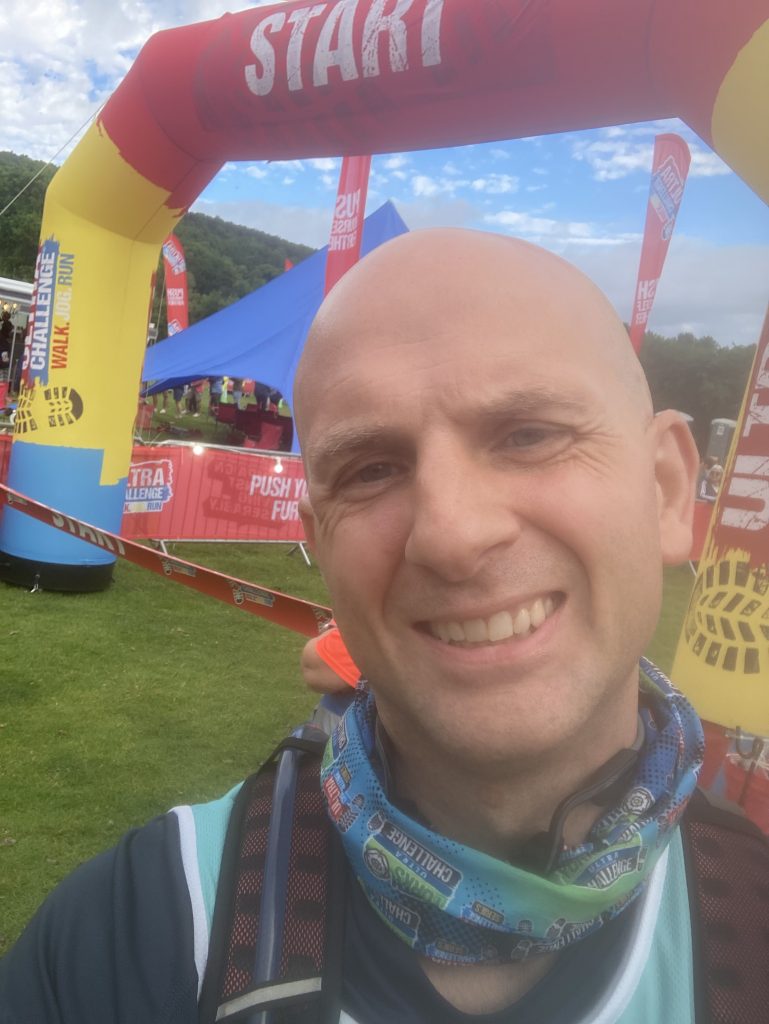
The experience also gave him the event bug. From there, Joe progressed to his first 50-kilometre ultramarathon. Since then, he has completed six 100-kilometre ultramarathons and another 50-kilometre event. Most of these challenges have also raised funds for charity.
With every event, Joe has learned more about his body, his capabilities and his limits.
“Each time, I push myself a little further and learn more about my limits,” he says.
Although Joe walks rather than runs, he often completes 100 kilometres in a similar time to some joggers, with around 15 to 16 hours of movement. Yet for Joe, the greatest achievement is not the pace or the finishing time. It is having found something that helps him feel physically and mentally stronger. “The events give me great personal satisfaction,” he says. “Walking is really the only thing I have ever felt I have excelled at.”
Learning when to stop
Joe’s latest ultramarathon, completed in September in support of AISIF Member, the National Axial Spondyloarthritis Society (NASS), brought an unexpected challenge.
After the event, Joe learned that he had completed it with fractures in his lumbar spine following a fall the previous week. The injury made his recovery much slower than expected.
His experience is an important reminder that new or unusually severe pain should be medically assessed and should not automatically be attributed to axSpA. Determination is important, but so are rest, recovery and knowing when to stop.
What progress looks like
For one person, progress might mean a 100-kilometre event. For someone else, it might mean a short walk, a gentle stretch, swimming, cycling or moving a little more comfortably than the day before. There is no single distance, speed or activity that defines success. What matters is finding movement that works for you, building gradually, listening to your body and seeking advice when something does not feel right.
Every event has taught Joe something new about his body, his limits and what he can achieve. But the greatest value of walking is not measured by distance or finishing time.
It is found in the clearer head, freer movement and sense of possibility it gives him every day.
“Walking is my mental and physical happy place. It helps me every day, and the events give me a sense of achievement that I have never found anywhere else.”
Other NEWS
Progress in axSpA care
PERSPECTIVE FROM ALFASIGMA Progress in axSpA care: defining success together Over the …
Read More
More Than a Diagnosis: My Journey With axSpA
By Luis Guzman I am 41 years old and I live …
Read More
Moving Forward with AxSpA
Two people, two endurance stories and one shared determination to …
Read More